Fitness Financial Model in Excel (Free Gym & Membership Download)
A gym or fitness financial model projects membership revenue (members × monthly fee) plus personal-training and class income against rent, staffing and equipment fit-out CAPEX, producing linked statements with payback period and IRR. Generate the full 16-sheet Excel model free for up to 3 years.
⚡ Generate my Fitness / Wellness model — free (requires JavaScript)
The fastest way to an investor-ready fitness / wellness financial model is a template pre-loaded with the industry's real revenue drivers and cost structure. This generator builds a 16-sheet, fully formula-linked Excel workbook — three statements, DCF & IRR — around fitness / wellness-specific assumptions in about five minutes. Free up to 3 years, just your email.
Key drivers pre-loaded in this template
| Members × fee | Recurring membership revenue |
| PT & classes stream | High-margin ancillary income |
| Fit-out CAPEX $400k default | Equipment with depreciation |
| Rent $12k/month default | Location-driven fixed cost |
What you get
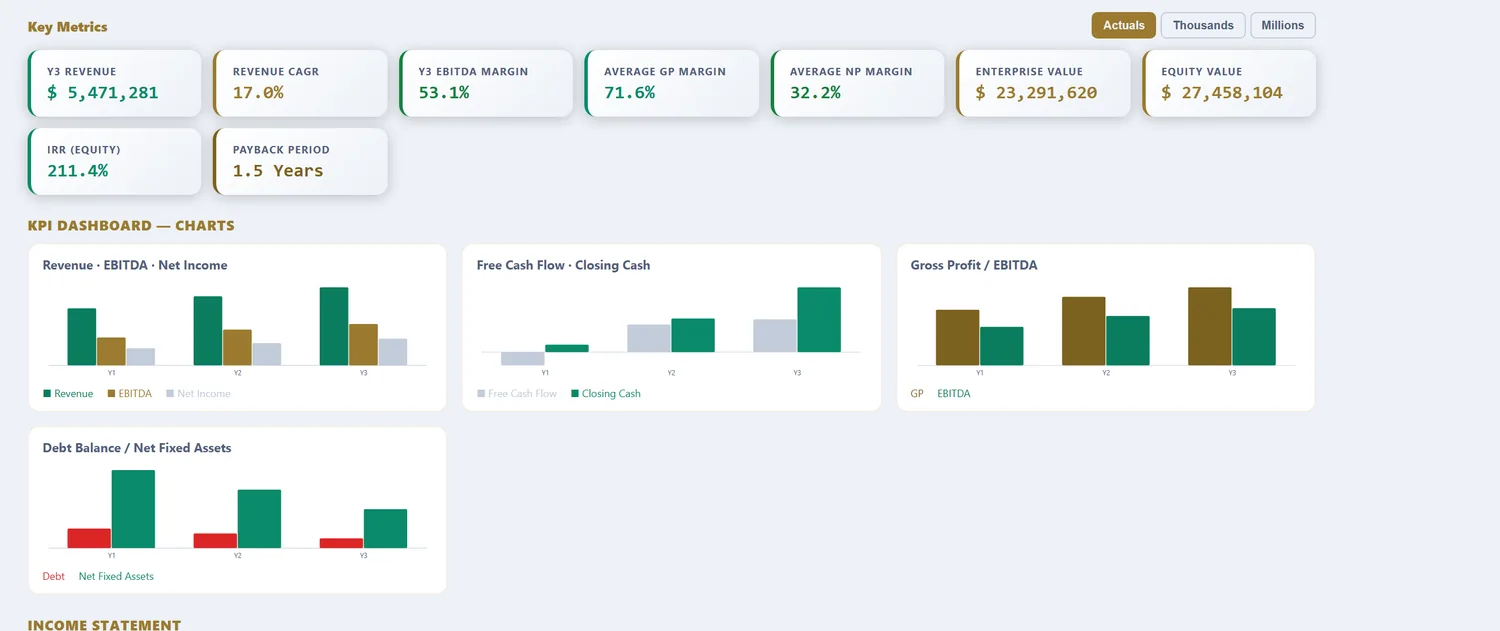
A 16-sheet, fully formula-linked Excel workbook: Assumptions, Revenue, OPEX, CAPEX & Depreciation, Debt, Tax (with loss carryforward), Income Statement, Cash Flow, Balance Sheet, DCF Valuation, Sensitivity tables, a charted KPI Dashboard, a Scenarios sheet (Base, Best & Worst), and an Integrity Check. Free 16-sheet linked Excel download for models up to 3 years (annual or quarterly, just your email). Models from 5 to 25 years are $29.98 per model download.
What a fitness financial model computes
A gym is a recurring-revenue business built on a fixed cost base, and the model exists to show whether members fill the club faster than they leave it. Revenue is members multiplied by a monthly fee, plus the ancillary income, personal training, classes and retail, that often carries the real margin. The costs are largely fixed: rent, core staff and the fit-out that had to be built before the first member joined. The two forces that decide the outcome are member growth against churn on the revenue side, and capacity fill against a fixed cost on the operating side. A generic template treats membership like ordinary revenue and misses both the churn dynamic and the ancillary margin that define fitness economics.
The template loads club-scale defaults: membership revenue from members and fees plus personal training, staff and rent as the fixed base, and fit-out CAPEX on the schedule. What follows is what each part does with real fitness numbers in it.
Club types change the model
Before any numbers, the club format sets the fee, the cost base and the member rhythm.
| Type | Revenue basis | Cost base | Modelling focus |
|---|---|---|---|
| Budget / high-volume | Low fee, many members | Lean staff, big box | Volume, churn, capacity |
| Premium / boutique | High fee, fewer members | High staff, experience | Retention, class utilization |
| Full-service health club | Membership + amenities | Heavy fixed cost | Ancillary mix, retention |
| Studio (single-discipline) | Class packs or membership | Instructor-led | Class fill, package pricing |
A budget club lives on volume, packing in members at a low fee against a lean cost base, so capacity and churn drive it. A boutique charges a premium to fewer members and lives on retention and the class experience. A full-service health club layers pools, spas and amenities on top, raising both revenue and fixed cost, so the ancillary mix matters. A studio sells classes or packages around a single discipline, turning on class fill. The model keeps the format explicit because the same square footage is a very different business depending on how it is sold.
Membership, churn and ancillary revenue
Fitness revenue is a base to be grown, defended and monetised beyond the core fee.
| Component | What it is | Sign |
|---|---|---|
| Opening members | Base carried in | Base |
| + Joiners | New members signed | Add |
| − Churned members | Cancellations | Subtract |
| = Closing members | Base carried out | Result |
| × Fee + ancillary | Membership plus PT/retail | Revenue |
Net member growth is joiners minus churn, and the churn line is the one that quietly decides the trajectory, because at 3-5% monthly churn a club replaces a large share of its base every year just to stand still. Ancillary revenue is the margin multiplier: personal training and retail sold to existing members cost almost nothing to acquire and lift revenue per member well above the headline fee. The model separates joiners, churn and the revenue streams so a plan built on marketing to sign more members reads differently from one built on keeping and monetising the members already there.
The four assumptions that decide fitness returns
| Assumption | Typical range | Why it dominates |
|---|---|---|
| Member churn | 3-5% monthly | Erodes the recurring base |
| Capacity fill | Members vs sustainable max | Spreads the fixed cost |
| Monthly fee | Format-dependent | Revenue per member |
| Ancillary attachment | PT and retail share | The margin multiplier |
Churn erodes the base and compounds against you, so a small improvement is worth more than a marketing push. Capacity fill spreads the fixed cost of rent and staff, so a half-full club is the fastest way to lose money. The fee sets revenue per member. And ancillary attachment is the margin lever, because training and retail sold to the existing base carry high margin at near-zero acquisition cost. The model runs all four so a growth plan is judged on retention and revenue per member, not just on how many people signed this month.
Worked example: a mid-size gym, in numbers
| Input | Value |
|---|---|
| Members | 2,000 |
| Monthly fee | $40 |
| Membership revenue / yr | ~$960K |
| Ancillary (PT, retail) | +25% of membership |
| Monthly churn | 4% |
| Staff & rent | fixed base |
| Fit-out CAPEX | $800,000 |
| Capacity | ~2,500 sustainable |
From members to margin and IRR
2,000 members at a $40 monthly fee is roughly $960K of membership revenue, and personal training and retail add about 25% more, for around $1.2M total. Against a largely fixed base of rent and core staff, the operating margin for an established club lands in the mid-teens to low twenties once past the opening ramp. The sensitivity is all in churn and fill: at 4% monthly churn the club loses close to its entire base each year and must sign roughly 80 new members a month just to hold steady, so a one-point churn improvement drops heavily to profit. Fill the club toward its 2,500 capacity and the extra members ride a fixed cost base straight to margin. Over a 3 to 25-year horizon the model funds the periodic equipment refresh, carries the churn dynamic, and produces the DCF and IRR, where retention and ancillary attachment decide whether the club compounds or grinds. A second or third club changes the picture again, adding central overhead and the opening ramp of each new site, which the model stages so a multi-club rollout is judged on the same honest churn and fill economics as the first location.
The opening ramp and seasonality
Two timing effects shape a gym's cash that a flat model misses. First, the opening ramp: the fit-out and equipment are paid up front and rent and core staff run from day one, but membership builds over months, so a new club typically loses money through its first half-year and needs the working capital to survive to a full base. Second, seasonality: fitness demand spikes in January and fades through summer, so joiners and churn both swing with the calendar, and a club that budgets on flat membership is caught out when the spring cancellations arrive. The model stages the opening ramp and lets membership vary by period, so both the cash a new club needs and the seasonal swing of an established one are visible rather than assumed away.
Fitness model vs a generic financial model
| What differs | Generic model | Fitness financial model |
|---|---|---|
| Revenue driver | Price × volume | Members × fee, net of churn, plus ancillary |
| Growth quality | Single rate | Joiners vs churn separated |
| Margin lever | Blended | Ancillary attachment and capacity fill |
| CAPEX | Steady spend | Fit-out plus equipment refresh |
| Timing | Flat | Opening ramp and seasonality |
Membership, participation and spending benchmarks for grounding assumptions are published by industry bodies such as the Health & Fitness Association (formerly IHRSA), the standard reference for the fitness-club sector.
Reference: the Health & Fitness Association, the benchmark source for fitness-club membership and industry data.
How to download your fitness model (3 steps)
- Choose the Fitness / Wellness template. The members, fee, churn and fit-out defaults load as editable inputs.
- Set your own membership, fee, churn, ancillary attachment and capacity. Pick annual or quarterly periods and a 3 to 25-year horizon.
- Preview the linked statements, margin and IRR, then download the Excel workbook. Up to 3 years is free with just your email; longer horizons are a one-time purchase.
Three focused variants build on the same fitness engine: the fitness cash flow forecasting model for the opening cash gap, the fitness DCF valuation model for enterprise value and IRR, and the fitness free cash flow model for the fit-out-to-FCF bridge.
Frequently asked questions
How long until a gym breaks even?
The KPI dashboard computes your payback period automatically — typically 2–4 years for a well-located club.
What member growth should I assume?
The template defaults to 20% early growth tapering as the club matures; replace with your capacity-based estimate.
Can I model a studio chain?
Model each site separately, or aggregate sites into the revenue streams with blended assumptions.
Why is churn the most important number in a gym model?
Because gym revenue is recurring, and a member lost has to be replaced before the base even grows, at acquisition cost. Fitness churn is high, often 3-5% a month, so a club can sign hundreds of new members a year and barely grow if retention is weak. The model tracks churn as a primary driver, because improving it is usually cheaper and more powerful than pouring money into acquisition.
How do gyms make money beyond membership?
Ancillary revenue, and it often carries the margin. Personal training, classes, supplements and merchandise are sold to a base already through the door, so acquisition cost is near zero and the margin is high. A club relying on membership fees alone leaves money on the table; one with strong personal-training attachment can lift revenue per member substantially. The model keeps membership and ancillary streams separate so the true economics of each are visible.
What is the biggest challenge in a new gym's model?
The opening ramp against a fixed cost base. The fit-out and equipment are paid up front, and rent and core staff run from day one, but membership builds slowly, so a new club often loses money for months while it fills. That ramp sets the working capital a new gym actually needs, and a model that assumes a full membership base from opening hides the deepest part of the cash requirement.
Fitness across our four models
Fitness / Wellness Cashflow Forecasting Model · Fitness / Wellness DCF Valuation Model · Fitness / Wellness Free Cashflow Model
More industry financial models
SaaS / Subscription financial model · Data Center financial model · Real Estate financial model · Manufacturing financial model · Hotel / Hospitality financial model · E-commerce / Retail financial model · Healthcare / Clinic financial model · Fintech / Lending financial model · Energy / Solar financial model · Early-Stage Startup financial model · Restaurant / F&B financial model · Professional Services financial model · Logistics / Transport financial model · Education / Training financial model · Construction financial model · Media / Content financial model · Telecom / ISP financial model · Agriculture financial model · Pharma / Distribution financial model · Nonprofit / NGO financial model · Pricing
Free tools
WACC calculator · CAPM calculator · DCF calculator · IRR calculator · Inside the 16-sheet model · Glossary